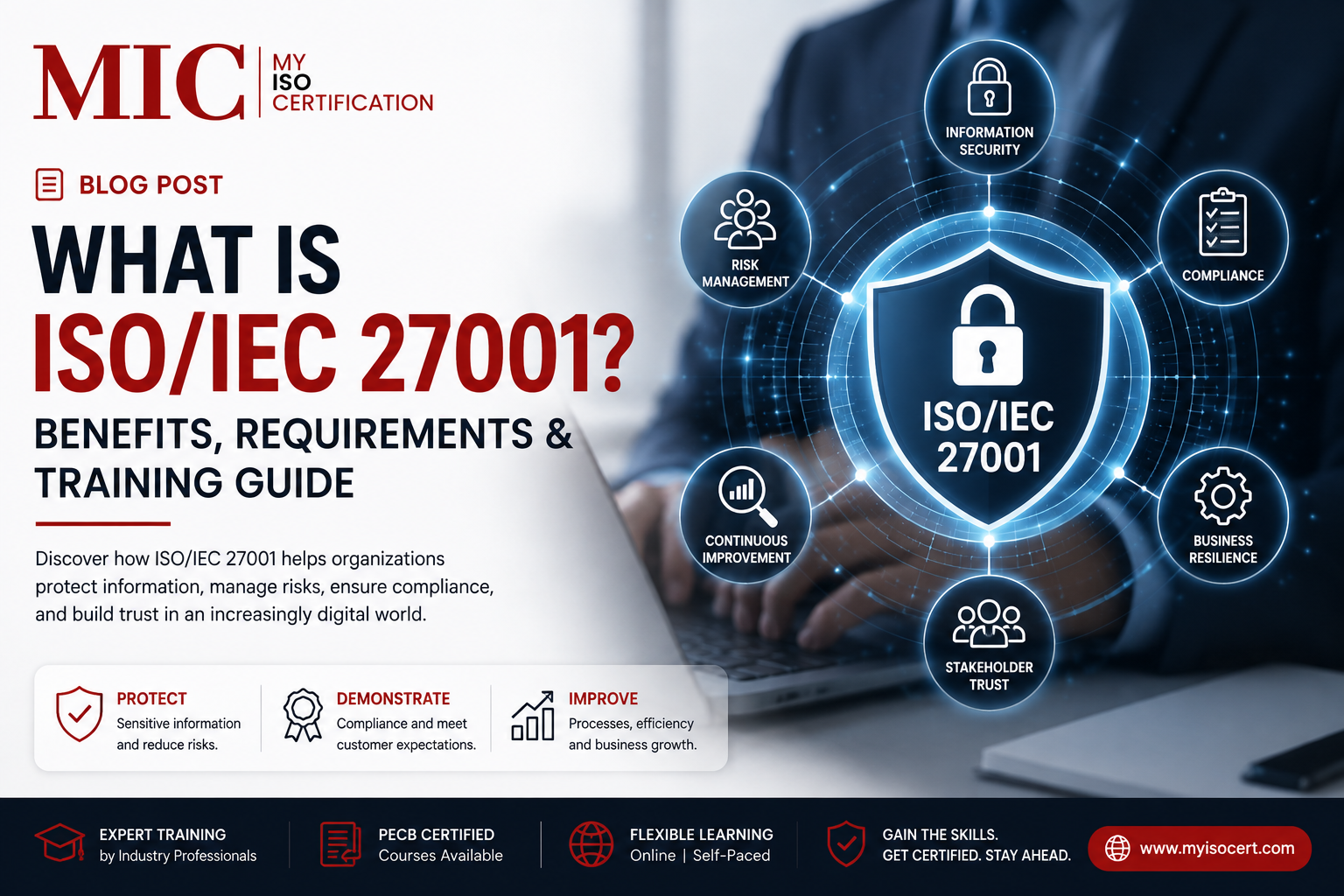
What Is ISO/IEC 27001? Benefits, Requirements & Training Guide
Published July 14, 2026 · Updated August 19, 2026 · 5 min read
What Is ISO/IEC 27001 and Why Is It Important for Organizations?
In a world where organizations increasingly depend on digital systems, cloud services, remote work, and online communication, protecting information has become a critical business priority.
Cybersecurity is no longer only an IT department concern. A security incident can affect operations, finances, customer trust, regulatory compliance, and an organization’s reputation.
This is where ISO/IEC 27001 plays an important role.
ISO/IEC 27001 is one of the world’s best-known standards for information security management. It provides organizations with a structured approach to protecting sensitive information and managing information security risks.
What Is ISO/IEC 27001?
ISO/IEC 27001 is an international standard that defines requirements for establishing, implementing, maintaining, and continually improving an Information Security Management System (ISMS).
An ISMS is a systematic framework that helps an organization identify information security risks and establish appropriate measures to manage them.
Rather than focusing only on technology, ISO/IEC 27001 considers information security from a broader organizational perspective.
This includes people, processes, technology, policies, responsibilities, risk management, and continual improvement.
The current edition, ISO/IEC 27001:2022, reflects the evolving information security environment and provides organizations with a risk-based framework for managing information security.
The Three Principles of Information Security
Information security is commonly built around three fundamental principles:
1. Confidentiality
Information should only be accessible to authorized individuals, systems, or organizations.
For example, employee records, customer information, financial data, passwords, and confidential business documents should be protected against unauthorized access.
2. Integrity
Information should remain accurate, complete, and protected against unauthorized modification.
Organizations need confidence that important information has not been improperly changed, deleted, or manipulated.
3. Availability
Information and systems should be available to authorized users when they are required.
Cyberattacks, system failures, human errors, and other disruptions can affect availability and potentially interrupt business operations.
Together, these principles are commonly known as the CIA triad: Confidentiality, Integrity, and Availability.
Why Is ISO/IEC 27001 Important?
Organizations manage significant amounts of valuable information every day.
Depending on the organization, this may include:
- Customer and employee information
- Financial records
- Intellectual property
- Contracts and legal documents
- Business strategies
- Authentication credentials
- Supplier information
- Internal communications
- Proprietary systems and processes
A security breach involving this information can result in financial losses, operational disruption, legal consequences, and reputational damage.
ISO/IEC 27001 helps organizations take a systematic and risk-based approach to information security rather than relying on individual or disconnected security measures.
Key Benefits of ISO/IEC 27001
Improved Information Security
ISO/IEC 27001 helps organizations identify their information security risks and determine appropriate ways to address them.
This allows security decisions to be based on actual organizational risks rather than assumptions.
Increased Customer and Stakeholder Confidence
Customers and business partners increasingly want assurance that organizations take information security seriously.
Implementing an internationally recognized information security framework can demonstrate a structured commitment to protecting sensitive information.
Better Risk Management
Every organization faces different information security risks.
ISO/IEC 27001 encourages organizations to identify threats and vulnerabilities, evaluate risks, establish appropriate controls, and continually monitor their effectiveness.
Clearer Security Responsibilities
Information security cannot depend solely on an IT team.
An effective ISMS establishes responsibilities across different levels of an organization, including management and employees.
Continual Improvement
Information security threats constantly evolve.
For this reason, ISO/IEC 27001 is not designed as a one-time project. Organizations are expected to monitor, review, maintain, and continually improve their ISMS.
Who Can Implement ISO/IEC 27001?
One of the strengths of ISO/IEC 27001 is that it can be applied to organizations of different sizes and industries.
It may be relevant to:
- Technology and software companies
- Financial institutions
- Healthcare organizations
- Government institutions
- Telecommunications companies
- Professional service providers
- Educational institutions
- E-commerce businesses
- Cloud and IT service providers
- Small and medium-sized enterprises
The appropriate implementation will depend on the organization’s context, operations, information assets, and risks.
ISO/IEC 27001 Is More Than Cybersecurity Technology
A common misconception is that ISO/IEC 27001 is primarily about installing cybersecurity tools.
Technology is certainly important, but an effective information security management system goes much further.
Organizations also need to consider areas such as:
Policies and procedures: How should information be handled and protected?
People: Do employees understand their information security responsibilities?
Access management: Who should have access to particular information and systems?
Incident management: What happens when a security incident occurs?
Supplier relationships: How are information security risks associated with external providers managed?
Business continuity: How will critical activities continue when disruptions occur?
Risk management: Which information security risks are most significant, and how should they be treated?
This broader approach is one of the reasons ISO/IEC 27001 is relevant to both technical and non-technical professionals.
ISO/IEC 27001 Training and Professional Development
As organizations strengthen their information security programs, professionals who understand ISO/IEC 27001 and information security management can play an important role in implementation, auditing, risk management, compliance, and continual improvement.
Depending on their responsibilities and career objectives, professionals may pursue training in areas such as:
ISO/IEC 27001 Foundation
Suitable for professionals who want to develop an understanding of the fundamental concepts and requirements of an Information Security Management System.
ISO/IEC 27001 Lead Implementer
Designed for professionals seeking to develop the knowledge and competencies needed to support organizations in implementing and managing an ISMS based on ISO/IEC 27001.
ISO/IEC 27001 Lead Auditor
Focused on developing competencies related to auditing an ISMS and assessing its conformity with ISO/IEC 27001 requirements.
These learning paths can be relevant to information security professionals, consultants, auditors, managers, IT professionals, compliance specialists, and individuals seeking to develop their careers in information security.
Building Information Security Knowledge
Implementing strong information security practices requires more than simply responding to cyber threats when they occur.
Organizations increasingly need professionals who understand how security, risk management, governance, compliance, and business processes work together.
Developing knowledge of internationally recognized standards such as ISO/IEC 27001 can therefore benefit both organizations seeking stronger information security management and professionals looking to expand their expertise.
Start Your ISO/IEC 27001 Learning Journey
At My ISO Certification (MIC), we provide access to professional training opportunities designed to help individuals develop knowledge and competencies related to internationally recognized ISO standards.
Whether you are beginning your journey in information security or looking to advance your professional expertise, ISO/IEC 27001 training can provide a structured pathway for developing valuable knowledge in information security management.
Explore our ISO/IEC 27001 training courses to find the learning path that best matches your professional goals.
Ready to get certified?
Browse all PECB courses.