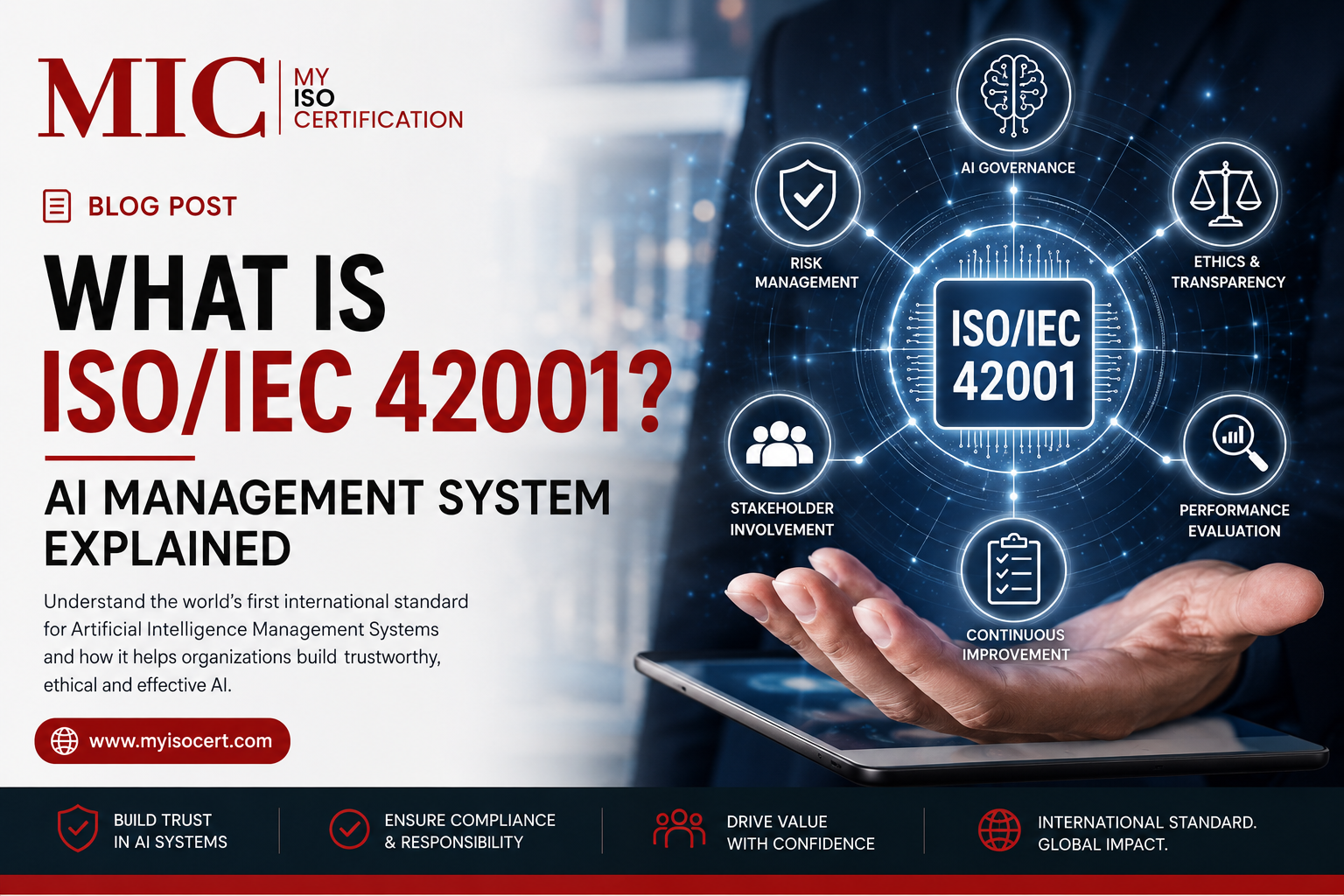
What Is ISO/IEC 42001? AI Management System Explained
Published August 18, 2026 · Updated August 19, 2026 · 6 min read
AI Management System Explained
Artificial intelligence is rapidly changing how organizations operate, make decisions, interact with customers, analyze information, and develop new products and services.
As the use of AI grows, so do questions around risk, transparency, accountability, security, data quality, and responsible use.
This is where ISO/IEC 42001 becomes increasingly important.
ISO/IEC 42001 provides organizations with a structured framework for managing artificial intelligence responsibly through an Artificial Intelligence Management System (AIMS).
What Is ISO/IEC 42001?
ISO/IEC 42001:2023 is an international management system standard for artificial intelligence.
It specifies requirements for establishing, implementing, maintaining, and continually improving an Artificial Intelligence Management System (AIMS) within an organization.
The standard is designed for organizations that develop, provide, or use AI-based products, systems, and services.
Rather than focusing exclusively on AI technology itself, ISO/IEC 42001 takes a broader management approach.
It helps organizations consider questions such as:
- How is AI used within the organization?
- What risks may arise from its use?
- Who is responsible for AI-related decisions?
- How should AI systems be monitored?
- What controls should be established?
- How can the organization continually improve its approach to AI?
This makes ISO/IEC 42001 relevant not only to technical teams, but also to management, governance, risk, compliance, legal, security, and other business functions.
What Is an Artificial Intelligence Management System?
An Artificial Intelligence Management System (AIMS) provides a structured way for organizations to govern and manage their use or development of artificial intelligence.
Similar to how an Information Security Management System (ISMS) provides a framework for managing information security, an AIMS provides a management framework focused specifically on AI.
An effective AIMS can help an organization establish policies, responsibilities, objectives, processes, risk-management practices, monitoring activities, and continual improvement mechanisms related to AI.
The goal is not simply to use more AI.
The goal is to manage AI systematically and responsibly.
Why Is ISO/IEC 42001 Important?
AI can create significant opportunities for organizations, but it can also introduce new risks.
These may include concerns relating to:
- Data quality
- Privacy
- Information security
- Bias and fairness
- Transparency
- Accountability
- Reliability
- Human oversight
- AI-generated outputs
- Third-party AI providers
- Regulatory and contractual requirements
For example, an organization might use AI to assist with recruitment, customer service, fraud detection, document analysis, cybersecurity, or business decision-making.
The risks associated with each use case can be very different.
ISO/IEC 42001 provides a structured framework for organizations to identify and manage these issues rather than approaching AI governance on an ad-hoc basis.
Who Is ISO/IEC 42001 For?
ISO/IEC 42001 can be relevant to organizations of different sizes and industries.
This can include:
- AI and technology companies
- Software developers
- Financial institutions
- Healthcare organizations
- Government institutions
- Professional service providers
- E-commerce companies
- Educational organizations
- Cloud service providers
- Organizations integrating AI into existing business processes
Importantly, an organization does not necessarily need to develop its own artificial intelligence models for AI management to be relevant.
Organizations increasingly use third-party AI tools and services, which can also create governance and risk-management considerations.
What Are the Benefits of ISO/IEC 42001?
Structured AI Governance
ISO/IEC 42001 can help organizations establish clearly defined responsibilities, policies, objectives, and processes for managing artificial intelligence.
Instead of allowing different departments to adopt AI independently without common governance, organizations can develop a more coordinated approach.
Better AI Risk Management
Different AI systems introduce different levels and types of risk.
A structured management system helps organizations identify, analyze, evaluate, and address risks associated with their AI activities.
Greater Accountability
As AI becomes involved in increasingly important processes, organizations need to understand who is responsible for decisions involving AI.
ISO/IEC 42001 encourages organizations to establish appropriate roles and responsibilities around their AI management activities.
Increased Trust
Customers, partners, employees, and other stakeholders increasingly want to understand how organizations are using artificial intelligence.
A systematic approach to AI management can help demonstrate that AI-related risks and responsibilities are being considered rather than ignored.
Continual Improvement
Artificial intelligence is developing extremely quickly.
A governance framework established today may need to evolve as technologies, risks, regulations, and business practices change.
ISO/IEC 42001 incorporates continual improvement into the management system approach, helping organizations adapt over time.
ISO/IEC 42001 and ISO/IEC 27001: What Is the Difference?
ISO/IEC 42001 and ISO/IEC 27001 address different but potentially complementary areas.
ISO/IEC 27001 focuses on establishing and managing an Information Security Management System (ISMS).
ISO/IEC 42001 focuses on establishing and managing an Artificial Intelligence Management System (AIMS).
In simple terms:
ISO/IEC 27001 → Information Security Management
ISO/IEC 42001 → Artificial Intelligence Management
An organization using artificial intelligence may have considerations relating to both areas.
For example, an AI system may process sensitive information, creating information security requirements while simultaneously creating AI-specific governance and risk-management considerations.
Why Should Professionals Learn ISO/IEC 42001?
AI governance is becoming an increasingly important professional discipline.
Organizations adopting artificial intelligence need people who understand not only what AI can do, but also how it should be governed, monitored, assessed, and managed.
Knowledge of ISO/IEC 42001 may therefore be particularly relevant to professionals working in:
- Artificial intelligence
- Information security
- Governance, Risk and Compliance (GRC)
- Risk management
- Data protection and privacy
- IT management
- Management systems
- Internal auditing
- Consulting
- Compliance
- AI governance
Professionals who already work with standards such as ISO/IEC 27001 may also find ISO/IEC 42001 particularly interesting because of its management-system approach.
ISO/IEC 42001 Training Paths
Depending on your experience and professional objectives, different ISO/IEC 42001 training paths may be appropriate.
ISO/IEC 42001 Foundation
Foundation-level training can help professionals understand the fundamental concepts, principles, and requirements associated with an Artificial Intelligence Management System.
It can be a useful starting point for professionals who are new to ISO/IEC 42001 or AI management systems.
ISO/IEC 42001 Lead Implementer
Lead Implementer training is intended for professionals seeking to develop competencies related to establishing, implementing, maintaining, and continually improving an AIMS.
This path may be particularly relevant to consultants, managers, compliance professionals, AI governance specialists, and individuals responsible for AI management initiatives.
ISO/IEC 42001 Lead Auditor
Lead Auditor training focuses on developing competencies associated with auditing an Artificial Intelligence Management System against applicable requirements.
This path may be relevant to auditors, consultants, compliance professionals, and individuals involved in evaluating management systems.
Is ISO/IEC 42001 Worth Learning?
For professionals working around AI, cybersecurity, risk, compliance, governance, or management systems, ISO/IEC 42001 represents an important area of knowledge.
AI adoption is moving beyond experimentation and becoming part of everyday organizational operations.
As that happens, organizations need to answer a more difficult question:
How do we make sure AI is being managed responsibly?
Technology alone cannot answer that question.
Organizations need governance structures, policies, responsibilities, risk-management processes, monitoring, and continual improvement.
ISO/IEC 42001 provides a framework for building that structured approach.
Start Your ISO/IEC 42001 Learning Journey with MIC
As artificial intelligence continues to transform organizations and industries, understanding AI management and governance can become an increasingly valuable professional competency.
My ISO Certification (MIC) provides access to professional ISO/IEC 42001 training opportunities for individuals seeking to develop their knowledge of Artificial Intelligence Management Systems.
Whether you are beginning with the fundamentals, preparing to support the implementation of an AIMS, or developing auditing competencies, you can select an ISO/IEC 42001 learning path aligned with your professional goals.
Ready to Develop Your AI Management Expertise?
Explore our ISO/IEC 42001 Foundation, ISO/IEC 42001 Lead Implementer, and ISO/IEC 42001 Lead Auditor training options and take the next step toward developing your expertise in AI management systems.
Ready to get certified?
Browse all PECB courses.